When talking about culture and entertainment, there is simply no way around the world of gaming. Arguably the most complete form of art, gaming is economically larger than the music and film industries combined. Once a year, this exceptional industry gathers in Cologne for gamescom, the world’s biggest gaming expo.
Why we’re going
The easy answer? Numbers and scale. gamescom breaks records every year. This year: sold-out exhibitor spaces for the first time, almost 80 million people watching Opening Night Live and 368.000 visitors descending on Cologne. As the locals will tell you, for one week the city practically grinds to a halt.
But scale is not the reason. Scale you can read about.
The reason is that gamescom showcases what we at The Storytelling Company care about most: worlds worth entering. The level of dedication these worlds inspire surpasses almost any other form of media. Where else do thousands of people spend months creating costumes to celebrate a story they neither own nor are paid to promote? Nobody does this at a furniture fair.
Understanding how stories turn into communities, and communities into culture, is part of our job.
Elham Nizam & Daniele Denaro
For me, a gamescom veteran, Creative Strategist at The Storytelling Company, avid gamer and content creator, the event is equal parts inspiration, validation and exhaustion. That’s why I brought Daniele Denaro, our Head of Virtual Production, to balance my gaming-first perspective with a technology-focused lens.
Many firsts, and a palpable shift This year’s show highlighted just how global gaming culture has become. Nigeria celebrated its debut gamescom presence through Maliyo Games, while governments increasingly use the event to showcase local creative industries and attract investment. gamescom has grown from a consumer event into a cultural, commercial and geopolitical platform.
For us, that meant conversations with publishers, IP owners, marketing teams and technology partners to understand how they think about immersive experiences, where they sit strategically within organizations, and what role external creative partners can play.
One trend was impossible to miss: the center of gravity continues to shift eastward. Nearly half of the titles showcased during Opening Night Live came from China, South Korea and Japan. Publishers such as HoYoverse, Hypergryph, Tencent and NetEase weren’t simply present, they were defining the conversation.
For anyone interested in the future of entertainment IP, that’s a signal worth paying attention to. For Daniele, it meant asking: How can The Storytelling Company meaningfully translate its expertise in immersive and interactive experiences into the global gaming industry?
Tools to make it felt On the show floor, gaming’s biggest players unveiled the worlds audiences will spend the next few years inhabiting. Some booths were effectively attractions in their own right. At gamescom, access is measured in hours, and anticipation is measured in queue length.
The spectacle is impressive. But for Daniele, the more interesting story sat behind the spectacle: The tools driving these virtual worlds, real-time engines, performance capture, virtual cameras, procedural environments and increasingly AI-assisted workflows, are the same technologies reshaping film production, live experiences and branded entertainment.
The boundary between gaming and the rest of the entertainment industry continues to dissolve.
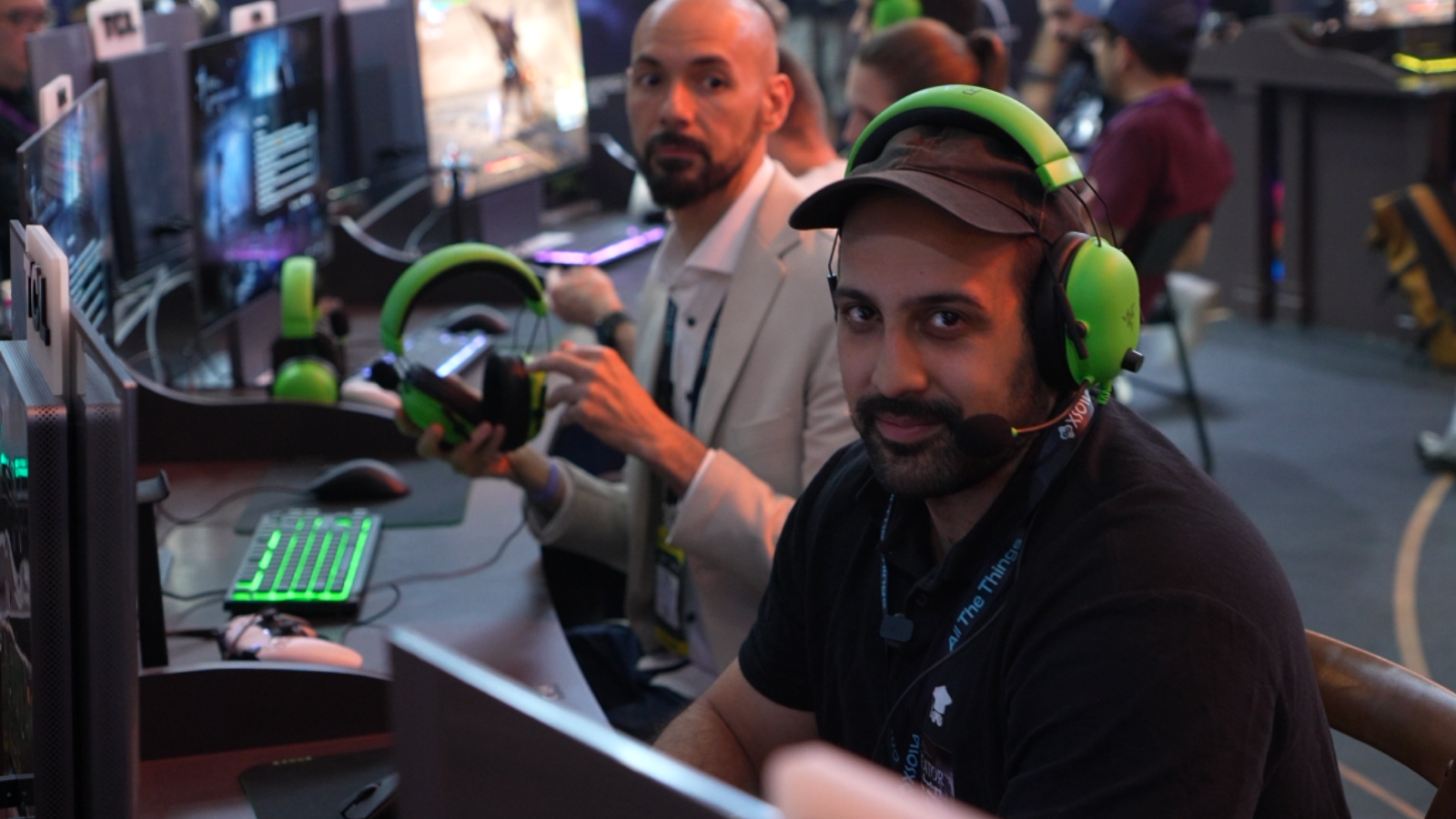
Elham Nizam (front) & Daniele Denaro
AI or not AI? What’s striking is that the industry has not yet settled on a single vision for AI. Some studios proudly minimize its role, while others see it as essential for scaling creation. Regardless of where individual companies land, the direction is clear: technology is accelerating content production, expanding creative possibilities and changing audience expectations. And gaming remains at the forefront of that transformation.
Back with a mission Even the presence of Apple and Google felt symbolic. After years of keeping a relatively low profile, both companies made visible efforts to strengthen their relationship with developers. When platform holders, publishers, creators and technology companies all converge in one place, you get a useful glimpse of where the wider media ecosystem is heading.
Equally telling were the absences. Some of the industry’s biggest brands - like GTA being absent but still dominating the conversation - chose not to show up in force, while cross-media activation felt rarer than in previous years. That creates opportunity. As franchises become larger and more culturally influential, the need to extend them into meaningful real-world experiences only grows.
Turning IP into ecosystems One thing became very clear, both from inside the event and from the perspective of an outside observer: intellectual property is no longer tied to a single medium.
Stories now move seamlessly between games, streaming platforms, social media, film, live experiences and creator communities. The era of isolated channels is over. The most successful IP are building ecosystems.
If you want a seat at that table, there is simply no way around connected gaming.
For The Storytelling Company, gamescom reinforced something we have believed for a long time: audiences don’t just consume stories anymore. They inhabit them, shape them and share them. The future belongs to the brands and IP that understand how to build worlds people genuinely want to enter.
Gaming is no longer a category of entertainment. It’s the engine of modern culture, and the world’s most valuable IPs are being built one world at a time.





.avif)


